Dehydroamino Acids
Overview
Dehydroamino acids (DHAAs) arise from a rare posttranslational modification termed eliminylation. DHAAs contain an electrophilic alkene that can lead to protein-protein crosslinking and secondary structure effects. In microorganisms, where they are most commonly observed, DHAAs are installed in proteins enzymatically, leading to the rapid sequestration of the modified protein. We have recently discovered DHAAs in HIV virions and in Alzheimer’s disease protein aggregates. We hypothesize that DHAAs significantly impact protein function, particularly by leading to their aggregation.
Significance
Protein aggregation is a widely studied phenomenon that may be influenced by several factors. Many suspect that posttranslational modifications play a significant role in the biological aggregation of proteins. For example, the protein Tau is known to aggregate in a variety of neurodegenerative diseases like Alzheimer’s disease and Parkinson’s disease. It is commonly suspected that Tau hyperphosphorylation is a necessary precursor for Tau aggregation. We suspect that dehydroamino acids, a modification often formed from phosphorylated intermediates, may also play a role in the aggregation of Tau and other proteins. Understanding the role of DHAAs in human biochemistry, particularly within disease, could provide novel therapeutic pathways that have not yet been discovered.
Previous discoveries of dehydroamino acids:
HIV-1 – In collaboration with Dr. Nathan Sherer, we identified DHAAs in HIV-1 capsid and matrix proteins and subsequently validated these findings using chemical derivatization strategies. Ongoing work focuses on understanding the role of DHAAs in HIV.
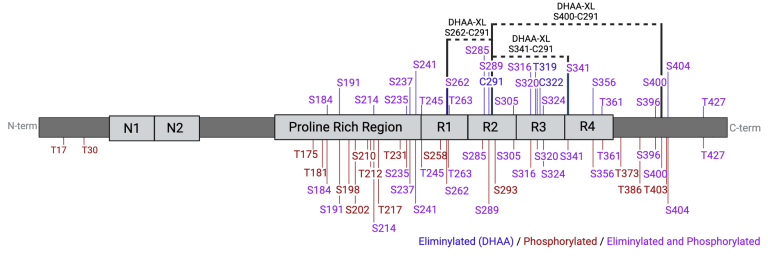
Alzheimer’s disease – Alzheimer’s disease is a neurodegenerative disease characterized by the aggregation of two protein species: amyloid-β and Tau. DHAAs have been consistently tied to protein aggregation, including in microorganisms and in the human eye. We identified DHAAs, their conjugates with glutathione and homocysteine, and protein-protein crosslinks within Tau and other aggregating proteins within protein aggregates extracted from human AD brain specimens.
Ongoing projects:
Work towards identification of dehydroamino acids in other neurodegenerative disease
Discovery of DHAAs in other neurodegenerative diseases – We’re expanding our DHAA discovery efforts into ALS, Parkinson’s, Lewy-body dementia, and chronic traumatic encephalopathy.
New proteomics tools – DHAAs are often low abundance modifications, thus the enrichment of DHAAs and their conjugates to permit better proteomic identification would be useful to understanding the full scope of DHAAs in the proteome. We are developing enrichment techniques to detect DHAAs, including unreacted forms, glutathionylated DHAAs, and native protein-protein crosslinks.
Aggregation assays – DHAAs have been previously tied to protein aggregation, yet they have never been shown to play a causal role. We are using chemically modified recombinant Tau protein in fluorescence-based assays to determine if the incorporation of DHAAs promote Tau aggregation.
Searching for a human DHAA-generating enzyme – We believe there is an enzyme within the human proteome capable of catalyzing the formation of dehydroamino acids. We are using a combination of computational tools, activity-based protein profiling experiments, and protein separations to identify the enzyme(s) responsible for dehydroamino acids in the human proteome.